
Total Knee Replacement in Scottsdale, Arizona
Muscle-sparing. Robotic-assisted. Your quadriceps stays intact. Recovery starts the same day. Back to golf in 4 to 6 weeks.
When Total Knee Replacement is the Right Choice
Find out when total knee replacement may be the best option for advanced knee arthritis, joint damage, and lasting pain relief.
Total knee replacement may be right for you if:
- Arthritis or damage has affected the entire knee joint — not just one compartment
- You have significant pain at rest and during activity
- Your knee is stiff or deformed
- Non-surgical treatments are no longer providing meaningful relief
- Imaging confirms advanced cartilage loss throughout the joint
Dr. Gough will review your imaging and examine your knee during your consultation to confirm whether total replacement is the right approach or whether a less invasive option — such as partial replacement — may be appropriate.
- MAKOplasty® Robotic Precision
- Muscle-Sparing Technique
- Back to Golf in 4–6 Weeks
- 25–30 Year Longevity
- Scottsdale, Arizona

WHY MUSCLE-SPARING MATTERS
The Key Difference: Muscle-Sparing Technique
See how Dr. Gough’s muscle-sparing knee replacement technique helps reduce pain, speed recovery, and protect the quadriceps muscle.
In traditional total knee replacement, the quadriceps muscle is cut to access the joint. This is the primary reason traditional recovery is so slow — patients are rebuilding a major muscle group from scratch in addition to recovering from the joint replacement itself. Dr. Gough’s approach preserves the quadriceps entirely. The joint is accessed through a technique that works around the muscle rather than through it. The result:
- Significantly less pain in the first days and weeks after surgery
- Faster return to walking, driving, and daily activities
- Reduced need for pain medication
- Back to light activities like golf in as few as 4 to 6 weeks
PRECISION, STEP BY STEP
How MAKOplasty® Total Knee Works
See how MAKOplasty® total knee replacement uses CT-based planning, robotic guidance, and patient-specific precision for better fit, alignment, and recovery.
|
|
|
|---|---|
|
STEP 1 >>> |
CT Scan — Before surgery, a CT scan of your knee is used to build a precise 3D digital model of your joint. |
|
STEP 2 >>> |
3D Surgical Planning — Dr. Gough uses the digital model to plan every aspect of the surgery — the exact position of the implant, the amount of bone to be removed, and how the new joint will move with your specific anatomy. |
|
STEP 3 >>> |
Custom Implant Selection — An implant is selected based on your anatomy. Unlike off-the-shelf sizing, this level of customization means a better fit, better alignment, and better long-term outcomes. |
|
STEP 4 >>> |
Robotic-Guided Procedure — During surgery, the Mako robotic arm provides real-time guidance. Every cut is precise. Every placement is accurate. The result is a knee that moves the way it should. |
Traditional Surgery vs. Dr Gough's Approach
Compare traditional total knee replacement to Dr. Gough’s muscle-sparing approach, including incision size, recovery time, hospital stay, and pain management.
Traditional Approach
- Incision: 10–12 inch incision
- Muscle Handling: Quadriceps cut or detached
- Recovery: 6–12 weeks
- Hospital Stay: 2–4 days
- Pain Medication: Narcotics commonly used
Dr Gough's Approach
- Incision: 4–6 inch incision
- Muscle Handling: Quadriceps fully preserved
- Recovery: Light activity in 4–6 weeks
- Hospital Stay: Home same day or within 24 hours
- Pain Medication: Most patients manage pain with Tylenol and Celebrex
BUILT TO LAST
About the Implant
Learn how modern knee implants are designed for smooth movement, long-term durability, and better performance when placed with precise robotic alignment.
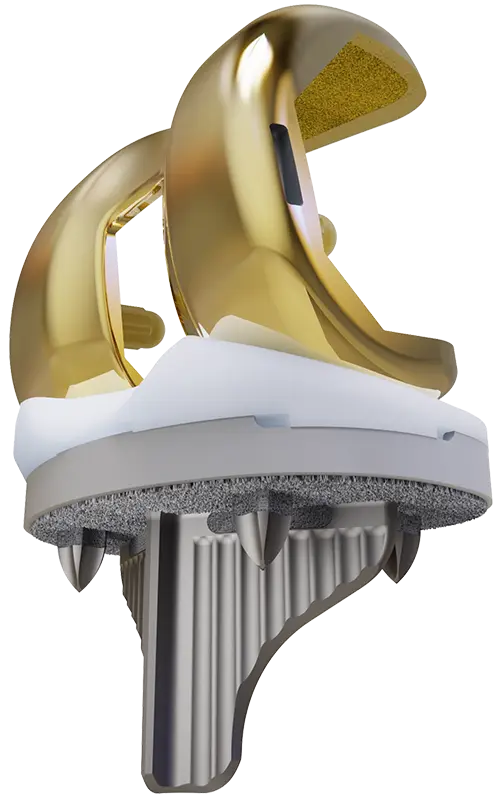
The prosthesis (artificial knee joint) replaces the damaged surfaces of the femur and tibia. It is made from durable, biocompatible materials — typically a combination of metal alloys and medical-grade polyethylene (a high-density plastic). These surfaces move smoothly against each other, replicating the function of healthy cartilage. Modern implants designed with these materials are built to last 25 to 30 years or more under normal activity. Dr. Gough’s precision robotic approach ensures optimal alignment — one of the most important factors in how long an implant performs well.
Your Recovery, Step by Step
What to Expect
See what recovery after total knee replacement typically looks like, from walking within hours to returning to daily activities and light recreation in just a few weeks.
|
|
|
|---|---|
|
Day of Surgery >>> |
Procedure takes 1 to 1.5 hours. Walking begins within hours. Most patients go home same day or within 24 hours. |
|
Days 1-7 >>> |
Mild swelling and discomfort managed with Tylenol or Celebrex. Walking with a walker. Physical therapy begins. |
|
Weeks 2-3 >>> |
Transition off walker to cane. Return to driving (non-surgical leg first). Many patients resume light activities. |
|
Weeks 4-6 >>> |
Many patients return to golf and similar light recreational activities. |
|
Weeks 6-8 >>> |
Physical therapy continues. Full activity for most patients by end of this period. |

HEAL SMARTER
Recovery Tips
Follow these simple recovery tips after total knee replacement to reduce swelling, protect your new joint, and support a smoother return to daily activity.
These simple tips can help reduce swelling, protect your knee, and support healing.
- Keep your knee elevated and supported when resting — this reduces swelling
- Use ice packs for 15 to 20 minutes several times a day in the first week
- Wear supportive, cushioned shoes whenever you are on your feet
- Avoid twisting, deep bending, running, or jumping until cleared by Dr. Gough
FREQUENTLY ASKED QUESTIONS
Total Knee Replacement FAQs
We know you might have questions about knee replacement surgery — here are the ones we get asked the most, answered simply.
Traditional total knee replacement requires cutting through the quadriceps muscle to access the joint --- which is the primary reason recovery typically takes 12 weeks to several months. Dr. Gough’s muscle-sparing technique works carefully around the quadriceps rather than through it. Combined with a smaller 4 to 6 inch incision (versus 10 to 12 inches with traditional surgery), MAKOplasty® robotic precision placement, and same-day discharge for most patients, his approach results in significantly less post-operative pain, a faster return to walking, and a quicker return to daily life.
Most of Dr. Gough’s total knee replacement patients manage post-surgical discomfort with Tylenol and Celebrex --- not narcotic pain medication. The muscle-sparing technique causes significantly less soft tissue trauma than traditional knee surgery, which translates directly to less post-operative pain. You will experience some swelling and soreness in the first week, which is normal and manageable. Dr. Gough’s team will provide a clear pain management plan before your surgery so you know exactly what to expect.
Many of Dr. Gough’s total knee replacement patients return to golf in as few as 4 to 6 weeks --- a timeline that would be unthinkable with traditional knee surgery. The MAKOplasty® robotic system combined with the muscle-sparing surgical technique are the two primary reasons recovery is this accelerated. Other activities such as hiking, swimming, and cycling are typically resumed within 4 to 8 weeks. Dr. Gough will provide a personalized activity plan based on your recovery progress and your specific lifestyle goals.
Simultaneous bilateral total knee replacement --- both knees at once --- is possible in carefully selected patients. There are potential advantages, including one recovery period instead of two. However, it requires greater physical and logistical demands during recovery. Dr. Gough will assess your overall health, cardiovascular fitness, recovery capacity, support system at home, and personal goals to determine whether simultaneous replacement is appropriate and safe for you.
Recovery from MAKOplasty® total knee replacement with Dr. Gough follows these general milestones.
- Day of surgery: walking with assistance, home same day or within 24 hours.
- Days 1 to 7: mild swelling managed with ice and over-the-counter medication, physical therapy begins.
- Weeks 2 to 3: transition off walker to cane, return to driving (non-surgical leg first).
- Weeks 4 to 6: many patients return to golf and light recreational activity.
- Weeks 6 to 8: physical therapy continues, full activity for most patients by the end of this period.
MAKOplasty® allows Dr. Gough to pre-plan your surgery using a 3D CT model of your specific knee --- before making a single incision. This means your implant is precisely sized, positioned, and angled for your anatomy rather than an average. During surgery, the robotic arm provides real-time guidance to ensure every cut and placement matches the pre-surgical plan exactly. Optimal implant alignment is the single strongest predictor of how long a knee replacement lasts and how well it functions. MAKOplasty® robotic precision reliably achieves alignment that is not consistently possible with traditional freehand techniques.